


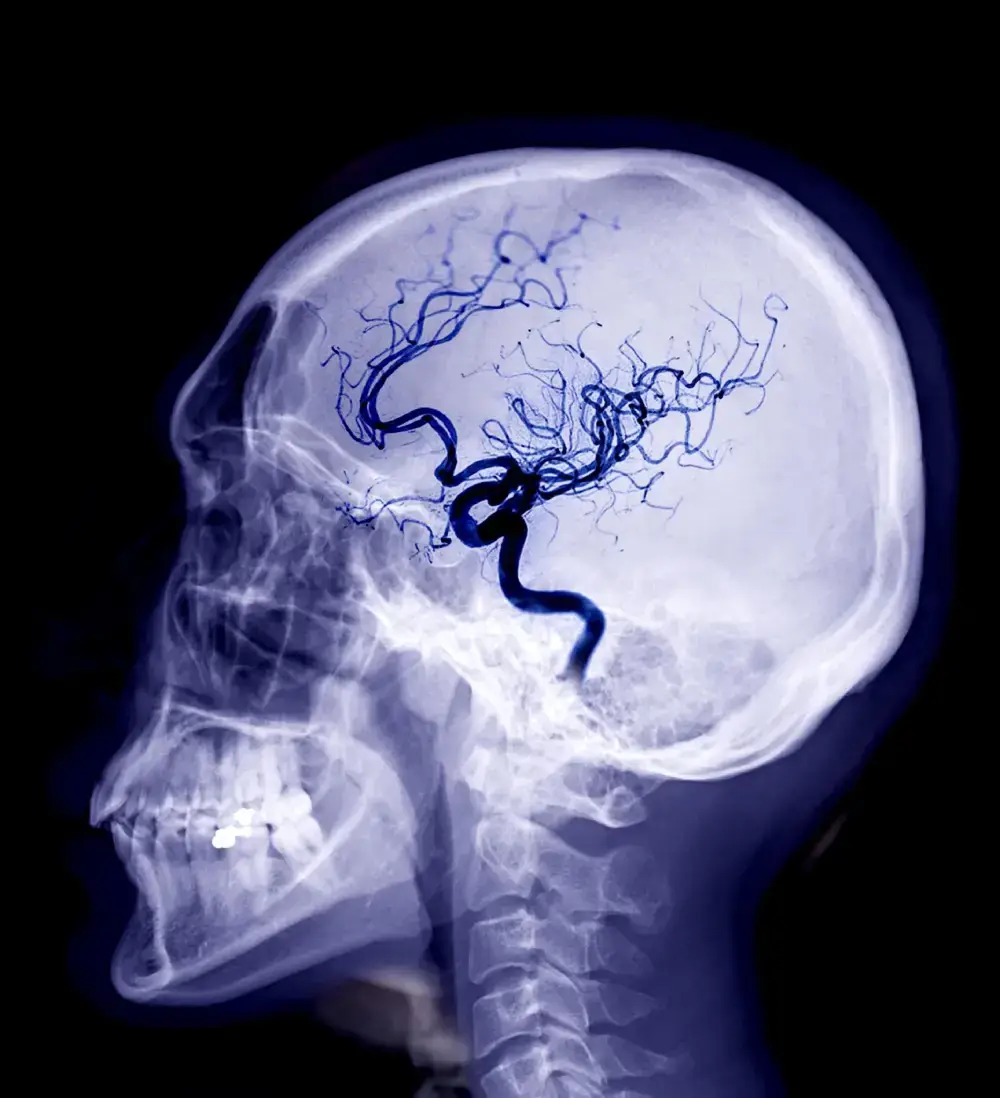
Some people learn they have an AVM after a seizure. Others find out by accident, from a scan ordered for a headache or a minor fall. Either way, the news is hard to absorb, especially once someone mentions the risk of bleeding.
If you’re researching arteriovenous malformation treatment, you probably have a long list of questions. Here are the ones we hear most often at Phoenix CyberKnife and Arizona Radiation Therapy Specialists, answered plainly.
What Exactly Is a Brain AVM?
An AVM is a tangle of abnormal blood vessels where arteries connect straight to veins, skipping the tiny capillaries that normally slow blood down. MedlinePlus explains that a cerebral AVM usually forms before birth. It isn’t cancer.
The center of the tangle is called the nidus. Because high-pressure arterial blood rushes directly into thinner-walled veins, those vessels are under constant strain. That strain is why bleeding is the main concern, and why some AVMs also cause seizures or headaches.
Many AVMs stay silent for years. Finding one doesn’t automatically mean an emergency. It does mean you deserve a careful, specialist review of your imaging before any decision is made, so you understand your own risk rather than a general statistic.
How Do Doctors Choose Arteriovenous Malformation Treatment?
It comes down to balance: the risk of the AVM bleeding over your lifetime versus the risks of treating it. Your team will consider its size, its location, your age, your symptoms, how it looks on imaging, and even plans for pregnancy.
There are three main tools, and they’re sometimes combined:
- Open surgery removes the AVM through an opening in the skull. It works well for some AVMs near the brain’s surface.
- Embolization threads a thin catheter through a blood vessel to the AVM and fills it with a glue-like material. It’s often used to shrink an AVM before other treatment.
- Stereotactic radiosurgery focuses radiation on the AVM with no incision at all.
Size and history matter, too. Smaller AVMs usually respond best to radiosurgery, while larger ones may need staged treatment or embolization first. If an AVM has already bled, treatment is often planned after the initial recovery.
For some people, careful monitoring is the right choice. The best decisions come from a team that usually includes a neurosurgeon, an interventional neuroradiologist, and a radiation oncologist.
How Does Radiosurgery Close an AVM?
According to MedlinePlus, radiation aimed directly at the AVM causes scarring and shrinkage, which lowers the risk of bleeding. It’s especially useful for small AVMs deep in the brain, where surgery would be risky. The MedlinePlus AVM overview is a good place for family members to read the basics.
Here’s what happens inside the vessel. Radiation injures the cells lining the abnormal vessel walls. Over time, the walls thicken and the channels narrow until blood can no longer flow through them. Healthy brain around the nidus receives far less radiation, thanks to the precision of our CyberKnife technology.
One honest point: this takes time. Closure usually happens gradually over one to three years, and the AVM can still bleed until it’s fully sealed. Your doctors will talk with you about what that waiting period means for you.
Many patients say the waiting is the hardest part. It helps to remember that radiosurgery keeps working quietly in the background while you go on with daily life, and that your team is watching closely the whole time.
What Happens on Treatment Day?
The process is calmer than most patients expect:
- Imaging: MRI, CT, and often an angiogram (a dye test that maps blood flow) show the exact shape of the nidus.
- Planning: your radiation oncologist outlines the target and protects nearby areas that control movement, speech, and vision.
- Treatment: you rest on a table in a soft custom mask while the robotic arm moves around you. It’s painless, and there’s no incision.
- Length: many plans take one to five sessions, depending on the AVM’s size and location.
- Afterward: most people go home the same day and keep taking any seizure medicine they’ve been prescribed.
- Follow-up: MRIs at set intervals, and often a final angiogram to confirm the AVM has closed.
More Questions Patients Ask
Q: Will insurance cover radiosurgery for an AVM?
A: In most cases, yes. Medicare and most private insurance plans cover it. Our team checks your benefits and helps with any paperwork before treatment begins.
Q: What side effects are possible?
A: Mild fatigue and headache are the most common in the first days. Some people develop swelling near the treated area months later; we watch for it with MRI, and it can usually be treated with medicine. We’ll review your specific risks at consultation.
Q: What symptoms mean I should go to the emergency room?
A: Call 911 for a sudden, severe headache, new weakness or numbness, trouble speaking or seeing, or a seizure. These can signal bleeding and need immediate care.
Get Clear Answers About Your AVM
AVMs are rare, so experience matters, and a second opinion is always welcome. Bring your MRI and angiogram images (on disc or through a patient portal), and our team will review them with you and give you an honest view of whether radiosurgery belongs in your arteriovenous malformation treatment plan.
Questions worth bringing to your appointment:
- How big is my AVM, and exactly where is it?
- What is my estimated risk of bleeding if we wait?
- How do the risks of surgery, embolization, and radiosurgery compare for me?
- How will we know when the AVM has closed?
Explore the conditions we treat, then find the Valley location closest to you to schedule a consultation.


